How CAO shipped 32 reviewed PRs, approved from my phone

I was on a family holiday in Bali, half watching the kid and half watching my phone, when it started buzzing: the CAO repo might need a look.
CI had gone red on two new HIGH-severity Dependabot alerts in the docs site's dependencies. Dependabot had already opened its own fix for each one, and both were red — each fix failed the scanner on the other alert.
A combined fix landed in one pull request, and it still wasn't green. This time on two MEDIUM alerts, in a dependency called minimatch.
CAO's architect — the agent whose job is to weigh security and policy calls, not just write code — looked into why a gate set for HIGH and CRITICAL severities was failing on a MEDIUM. In about 15 minutes, this agent found the root cause: the CI step that uploads the security report ignores its own severity filter once it switches to a certain output format. Then it proved both MEDIUM alerts were unreachable code in this repo — flagged, but never callable.
The fix was a scoped exemption: it named the exact advisory and the exact two files, and, lastly, it set an expiry date three months out so it can't be forgotten. That state was handed off to an independent reviewer, who checked it against the exact advisory and the live gate, with no shortcuts: no blocking issues, four minor nits to tidy up.
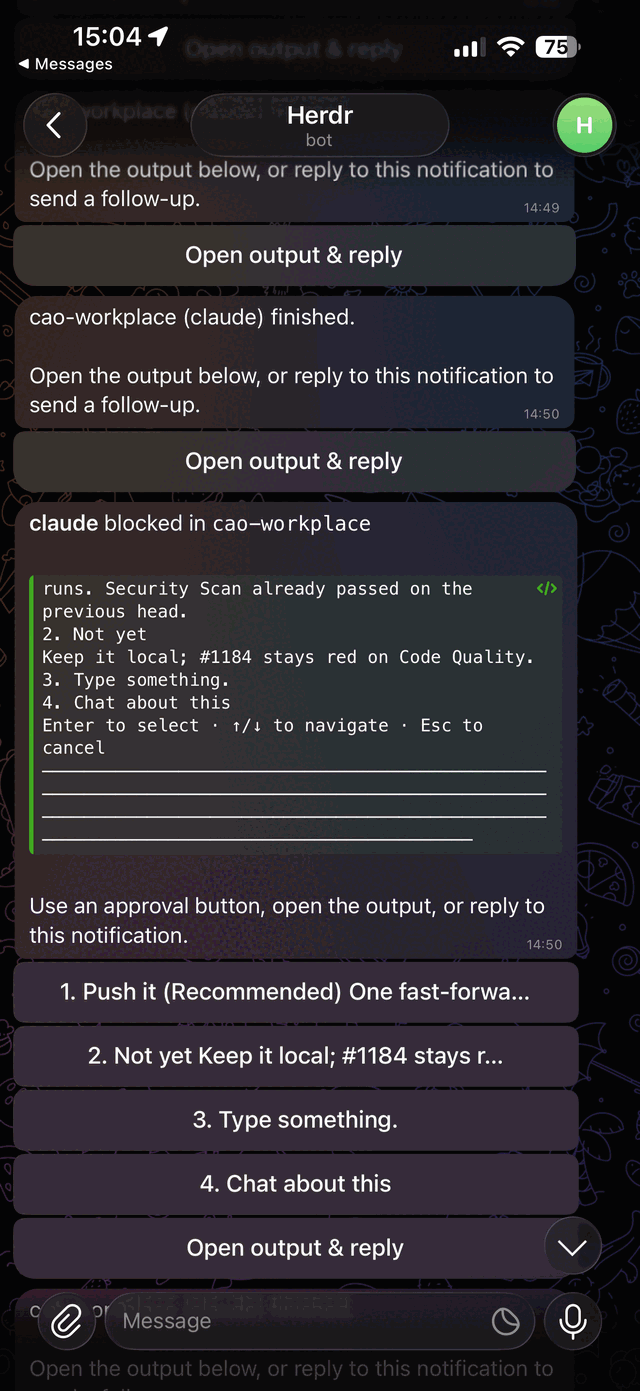 The moment of the tap: the Herdr bot asking whether to push #1184's formatting fix as a fast-forward.
Three of those nits went out in the next push, folded into one short follow-up commit. About 10 minutes later, there was one more catch: the Code Quality check flagged a formatting slip in the new guard test. The same agent picked it up, fixed it, and pushed once I approved.
By the time I'm writing this, every check is green — Security Scan included — and, after another contributor's review and approval (thanks for reviewing my PR!), it's merged.
That was one Saturday. Over twelve days, the same loop — CAO, the open-source CLI agent orchestrator, running a small team of agents against its own repo — shipped 32 pull requests on its own, asking me for approval before pushing a PR (or anything that reaches the remote, or touches something unexpected).