Stable Updates, Fewer Sequences: Better and Faster RL in ART
By Bryan Lu and Danylo Vashchilenko · September 28, 2026
One rollout, several training sequences
Section titled “One rollout, several training sequences”A coding agent reads a repository, runs a build, edits a file, and tries again. To the application, this is one rollout. To a reinforcement learning trainer, it may be several sequences, each with its own context and generated tokens. That distinction affects both how the model learns and how much work training requires.
In our earlier post, we described how AgentCore RL Toolkit (ART) trains agents through their existing model API calls. The rollout gateway sits between the agent harness and the inference backend. It converts messages into token IDs, sends those IDs to the backend, and captures the sampled tokens and their logprobs. This lets the trainer use the exact context under which each token was generated.
Here we look at what happens when those turns become training data. Two changes address different parts of the problem: stable optimizer-step batching in ART’s verl backend, and linear-history healing in the backend-independent gateway. The first handles a variable number of rows; the second reduces rows that need not exist in the first place.
Why a conversation can stop being append-only
Section titled “Why a conversation can stop being append-only”Each training sequence is stored as a row containing token IDs and a loss mask identifying the generated tokens to train on. Several turns can share one row when each turn’s input starts with the exact input and output tokens of the previous turn:
Turn 1: prompt → generated tool callTurn 2: [prompt + generated tool call] + tool result → next generationBut agent APIs exchange messages, not token IDs. The harness parses a tool call, executes it, and sends the conversation back as JSON. Reconstructing the previous assistant message can change whitespace, argument order, or template formatting. For example, these tool arguments represent the same mapping:
{"command": "mvn test", "timeout": 60}{"timeout": 60, "command": "mvn test"}Their text, and therefore their token sequences, can differ. A conversation that is append-only at the message level may no longer be append-only at the token level. Similar issues are discussed in No Token Left Behind.
ART’s default tree capture preserves the actual inference history. If a replayed prompt diverges from the previous token sequence, it forks the trajectory into another training row. Earlier generations retain their original contexts; the new row uses the context actually sent for the next generation. Shared history appears again as masked context, which still costs computation even though it does not contribute directly to the loss.
Some splits are necessary: an agent may compact context, edit history, or launch sub-agents. Others arise from re-serializing an otherwise linear conversation. Both produce variable rows: the number of training sequences is no longer determined by the number of rollouts requested.
Keep optimizer steps tied to the training configuration
Section titled “Keep optimizer steps tied to the training configuration”In ART’s original verl integration, training rows were grouped into mini-batches of a fixed size. Each mini-batch triggered an optimizer update. More rows could therefore mean more Adam steps, even when the source prompt batch and PPO epoch count were unchanged.
Consider our MigrationBench configuration: 32 source prompts, 16 rollouts per prompt, and a PPO mini-batch size of 32 source prompts. With one PPO epoch, the intended schedule is one optimizer update for that outer training batch.
| Rows emitted by 512 rollouts | Updates with fixed-row batching | Updates with fixed-step batching |
|---|---|---|
| 512 | 1 | 1 |
| 1,536 | 3 | 1 |
Three sequential Adam updates are not equivalent to accumulating the gradients and applying one update. After each update, both model parameters and optimizer state change. Allowing trajectory splitting to choose that count introduces a source of variation outside the configured training schedule.
The fix uses verl’s existing worker interface to specify the number of mini-batches, instead of their fixed row size. With this configuration:
mini-batches = source-prompt batch size / PPO mini-batch sizeoptimizer steps = mini-batches × PPO epochsAll rows are still consumed. A larger expanded batch requires more forward/backward work, but gradients accumulate within the configured mini-batches before the optimizer advances. Row losses remain additive, with the same normalization.
Padding follows the same schedule. Rows need only be divisible across mini-batches and data-parallel ranks. For one mini-batch and two ranks, 513 rows become 514, rather than being rounded up to the next 512-row multiple, 1,024.
MigrationBench: validation after the batching fix
Section titled “MigrationBench: validation after the batching fix”We evaluated a Strands migration agent using Qwen3-Coder-30B-A3B-Instruct with GRPO and LoRA training through verl and Megatron. MigrationBench asks the agent to upgrade Java repositories to Java 17 while preserving their tests.
In the batching comparison, both runs used tree capture and completed 101 outer training batches. We evaluated on 299 held-out tasks before training, every 15 batches, and at the end. The reported metric is mean validation reward: the evaluator awards 0.5 for a successful migration build and another 0.5 for test equivalence.
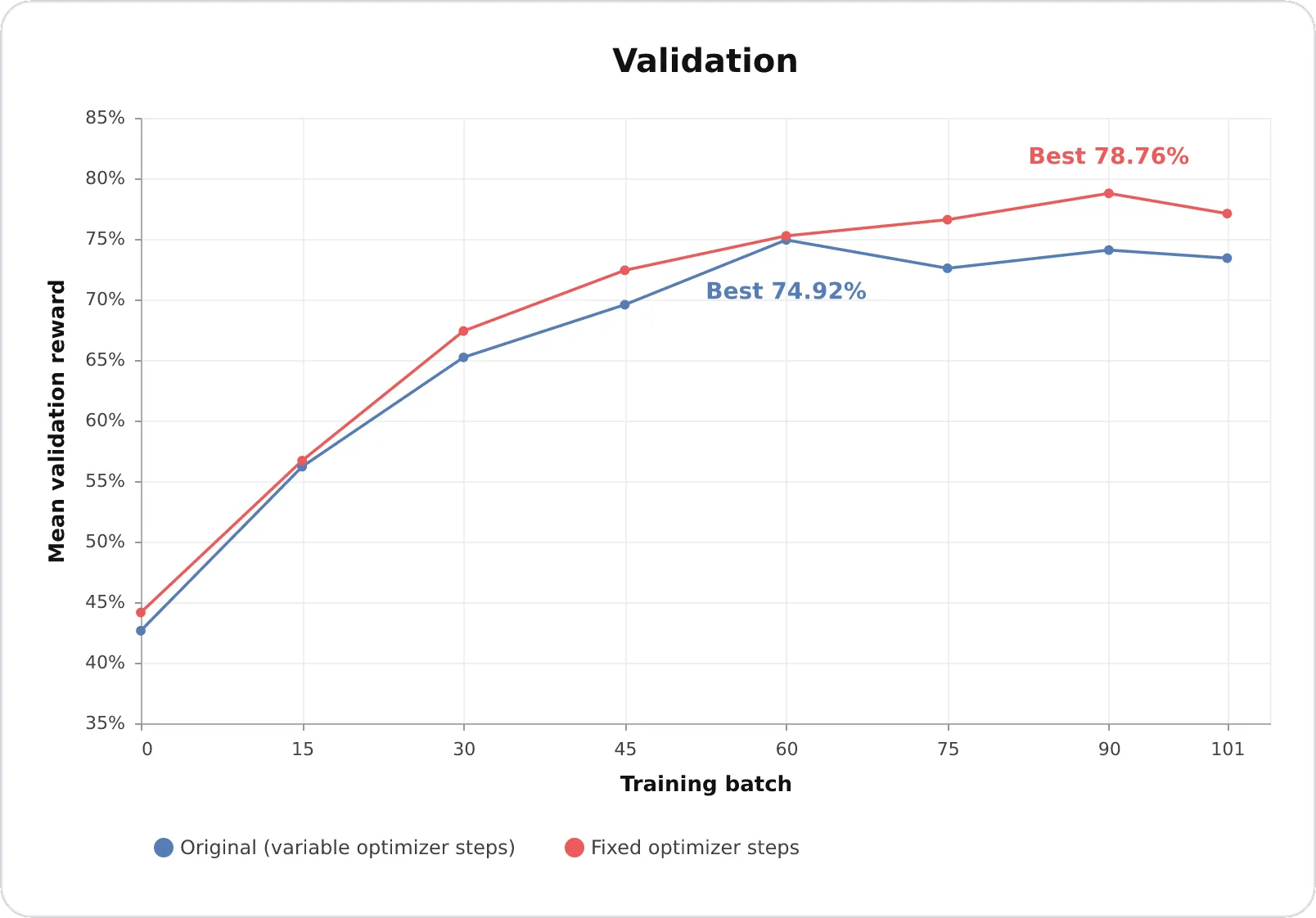
Best validation reward increased from 74.92% to 78.76%, a gain of 3.85 percentage points.
Preserve a linear history before generating the next turn
Section titled “Preserve a linear history before generating the next turn”Stable batching accommodates extra rows, but those rows still have to be processed. For a harness that intends to append to one conversation, the gateway can also prevent cosmetic token drift from creating those rows.
That is the purpose of linear mode. It combines two views of the history:
- Messages establish continuity. Protocol adapters normalize the incoming messages, including parsing tool arguments into dictionaries. The healer checks that the stored messages are a prefix of the incoming history and that the tools schema is unchanged. Dictionary key order does not affect this comparison; changing message content does.
- Tokens preserve context. The gateway retains the exact input IDs it sent and the exact output IDs the model generated. An earlier tool result keeps the tokens used when it first entered the context; an assistant response keeps its sampled tokens.
For a continuing conversation, the next input is constructed as:
next input = saved token history + missing assistant-closing tokens + tokens for new messages and the next assistant openingThe new messages include tool results or newly appended user instructions. The closing tokens are the chat template’s boundary after an assistant turn. Some may already be present in the sampled output, such as a retained stop token; the healer removes that overlap before appending anything.
The gateway constructs this input before inference. The model generates the next response using the preserved context, and the gateway records those same input IDs along with the resulting output IDs and logprobs. After a successful turn, it extends the saved history:
saved token history = next input + generated outputThis preserves training/inference context consistency while allowing an uninterrupted linear rollout to form one training sequence. It also means linear mode can change the token representation the model sees compared with message re-rendering. It is intended for harnesses where that replay drift is cosmetic, not an intentional edit to the conversation.
Extract the delta without tokenizing the whole history
Section titled “Extract the delta without tokenizing the whole history”Preserving the token history leaves one task for each new turn: efficiently identifying what needs to be appended.
One way to find this delta is to tokenize both the stored history and the extended conversation, then compare their token sequences. As conversations grow longer, this repeatedly processes a large history just to identify a small addition.
The insight is that applying the chat template is much cheaper than tokenizing its output. In an offline synthetic Qwen3-Coder measurement at approximately 100,000 tokens, median template rendering took 0.15 ms, compared with 137.03 ms for tokenization.
We therefore separate the two operations: render both histories to text, slice out the added portion, and tokenize only the fragments needed for the next turn.
Suppose a tool returns Build passed.. Applying the chat template to the stored
history, then to that history plus the tool result, produces these simplified
strings:
History:[earlier messages][assistant tool call][end marker]
History + tool result:[earlier messages][assistant tool call][end marker][tool result: Build passed.][assistant opening]
The first string is a prefix of the second. Slicing off that shared prefix gives the new text:
[tool result: Build passed.][assistant opening]Both renders use the complete stored history, allowing the template to consult earlier messages when formatting the next turn. The gateway tokenizes the extracted text, completes any missing template markers between turns, and appends the resulting tokens to the saved history. The previous input and sampled output token IDs remain unchanged. If the template changes the earlier text, the gateway falls back to full-history healing.
Why slice text before tokenizing? Tokenization can merge characters across the position where we want to split. For illustration, suppose a template places one newline at the end of the history and another at the start of the new text:
Text: ...\n | \n...Encoded together: [271]Encoded separately: [198] | [198]The Qwen3-Coder tokenizer represents one newline as [198] and two consecutive
newlines as [271]. Encoding the entire string produces a token spanning the
split. Text slicing identifies the new fragment directly, so it can be tokenized
separately and appended while preserving the saved tokens.
Encoding also uses the native async tokenizer, allowing the gateway’s HTTP event loop to serve other requests while tokenization runs.
Handling context changes
Section titled “Handling context changes”An agent may also edit or compact its history. When this happens, the
message-level prefix check fails, and the default reset policy starts a new
linear segment from the incoming prompt. Capture can split at that boundary,
and subsequent append-only turns can be healed again.
Other policies can raise an error or disable healing for the rest of the session. Tree mode remains the appropriate choice for general branching histories. A linear segment can occupy one row; edits or compaction may split a session into several. This is why linear mode complements, rather than replaces, support for variable-row batching.
MigrationBench: fewer sequences and less training work
Section titled “MigrationBench: fewer sequences and less training work”For the efficiency comparison, we ran a separate tree-versus-linear pair with the same code, training data, model, and training configuration, changing the history mode. Both used fixed optimizer-step batching and completed 101 outer training batches. The table reports totals for those runs.
| Metric | Tree mode | Linear mode | Reduction |
|---|---|---|---|
| Training sequences | 138,830 | 51,697 | 62.76% |
| Processed training tokens | 2.29 billion | 1.69 billion | 26.53% |
| Actor-update time | 29.58 hours | 24.18 hours | 18.24% |
| End-to-end elapsed time | 114.06 hours | 104.28 hours | 8.57% |
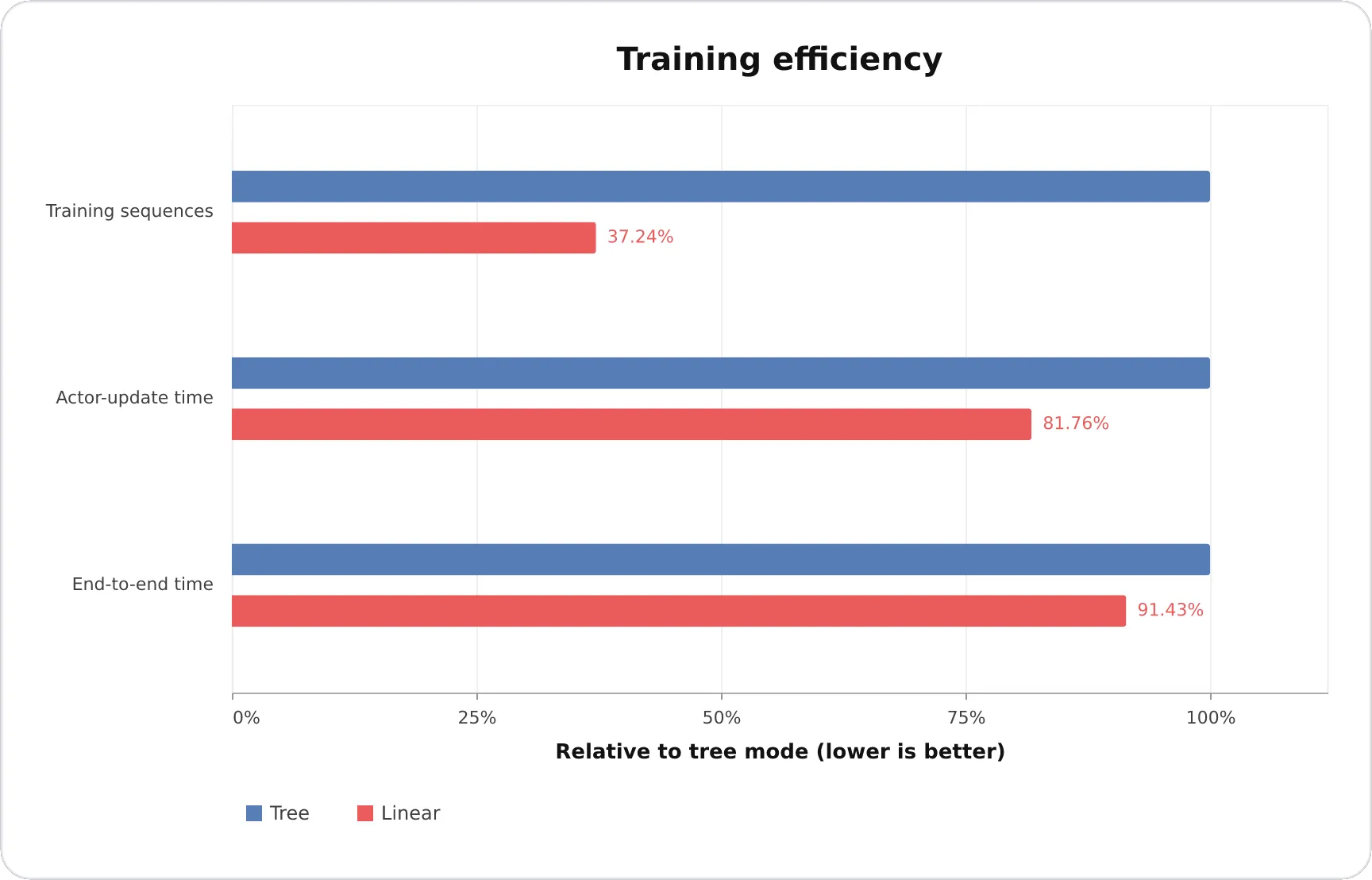
Linear mode saved 9.78 hours over the complete experiment. The end-to-end reduction is smaller than the actor-update reduction because agent execution, generation, and evaluation remain substantial parts of elapsed time. The totals include differences in generated trajectories as well as row consolidation.
The linear run reached a best validation reward of 78.26%, comparable to the 78.76% peak in the earlier tree-mode run.
These runs use synchronous training, so each batch waits for its slowest rollout. Linear mode may also speed up individual rollouts through better prefix-cache reuse; asynchronous training could translate those gains into higher overall throughput.
Using the two mechanisms together
Section titled “Using the two mechanisms together”The two changes act at different layers. ART’s verl integration keeps the optimizer-step schedule stable while consuming variable rows. The rollout gateway’s linear mode preserves token continuity when the harness intends a single append-only conversation, reducing unnecessary splits and repeated context processing.
The gateway handles this without requiring the agent harness to manage tokens. The agent continues using its model API, and the training backend continues receiving token-level trajectories.
Start with the verl setup guide
and the MigrationBench example.
Linear mode is selected with history_mode="linear" on the rollout gateway.
The implementation details and supported behavior are documented in the
variable-row batching design
and linear-history design.