Loading...
Searching...
No Matches
Rtcp.h File Reference
This graph shows which files directly or indirectly include this file:

Go to the source code of this file.
Enumerations | |
| enum | TWCC_STATUS_SYMBOL { TWCC_STATUS_SYMBOL_NOTRECEIVED = 0 , TWCC_STATUS_SYMBOL_SMALLDELTA , TWCC_STATUS_SYMBOL_LARGEDELTA } |
Functions | |
| STATUS | onRtcpPacket (PKvsPeerConnection, PBYTE, UINT32) |
| STATUS | onRtcpRembPacket (PRtcpPacket, PKvsPeerConnection) |
| STATUS | onRtcpPLIPacket (PRtcpPacket, PKvsPeerConnection) |
| STATUS | createRtcpPLIPacket (UINT32, UINT32, PBYTE, PUINT32) |
| STATUS | parseRtcpTwccPacket (PRtcpPacket, PTwccManager) |
| STATUS | onRtcpTwccPacket (PRtcpPacket, PKvsPeerConnection) |
| STATUS | updateTwccHashTable (PTwccManager, PINT64, PUINT64, PUINT64, PUINT64, PUINT64) |
| STATUS | computeTwccTrendline (PTwccManager, PDOUBLE, PDOUBLE) |
| Estimates network congestion trend using least-squares linear regression on accumulated one-way delay variations, smoothed with an exponential moving average (EMA). | |
Macro Definition Documentation
◆ IS_TWCC_RUNLEN
| #define IS_TWCC_RUNLEN | ( | packetChunk | ) |
Value:
((((packetChunk) >> 15u) & 1u) == 0)
◆ MICROSECONDS_PER_SECOND
| #define MICROSECONDS_PER_SECOND 1000000LL |
◆ MILLISECONDS_PER_SECOND
| #define MILLISECONDS_PER_SECOND 1000LL |
◆ RTCP_PLI_PACKET_LEN
| #define RTCP_PLI_PACKET_LEN (RTCP_PACKET_HEADER_LEN + 2 * SIZEOF(UINT32)) |
◆ TWCC_ESTIMATOR_TIME_WINDOW
| #define TWCC_ESTIMATOR_TIME_WINDOW (4 * HUNDREDS_OF_NANOS_IN_A_SECOND) |
◆ TWCC_FB_PACKETCHUNK_SIZE
| #define TWCC_FB_PACKETCHUNK_SIZE 2 |
◆ TWCC_FB_PAYLOAD_MIN_LEN
| #define TWCC_FB_PAYLOAD_MIN_LEN 16 |
◆ TWCC_IS_NOTRECEIVED
| #define TWCC_IS_NOTRECEIVED | ( | statusSymbol | ) |
Value:
((statusSymbol) == TWCC_STATUS_SYMBOL_NOTRECEIVED)
◆ TWCC_ISRECEIVED
| #define TWCC_ISRECEIVED | ( | statusSymbol | ) |
Value:
((statusSymbol) == TWCC_STATUS_SYMBOL_SMALLDELTA || (statusSymbol) == TWCC_STATUS_SYMBOL_LARGEDELTA)
◆ TWCC_MAX_PACKET_STATUS_COUNT
| #define TWCC_MAX_PACKET_STATUS_COUNT 2048 |
◆ TWCC_PACKET_LOST_TIME
| #define TWCC_PACKET_LOST_TIME ((UINT64) (-1LL)) |
◆ TWCC_PACKET_STATUS_COUNT
| #define TWCC_PACKET_STATUS_COUNT | ( | payload | ) |
Value:
(getUnalignedInt16BigEndian((payload) + 10))
◆ TWCC_PACKET_UNITIALIZED_TIME
| #define TWCC_PACKET_UNITIALIZED_TIME 0 |
◆ TWCC_RUNLEN_GET
| #define TWCC_RUNLEN_GET | ( | packetChunk | ) |
Value:
((packetChunk) & 0x1fffu)
◆ TWCC_RUNLEN_ISRECEIVED
| #define TWCC_RUNLEN_ISRECEIVED | ( | packetChunk | ) |
Value:
TWCC_ISRECEIVED(TWCC_RUNLEN_STATUS_SYMBOL(packetChunk))
◆ TWCC_RUNLEN_STATUS_SYMBOL
| #define TWCC_RUNLEN_STATUS_SYMBOL | ( | packetChunk | ) |
Value:
(((packetChunk) >> 13u) & 3u)
◆ TWCC_STATUSVECTOR_COUNT
| #define TWCC_STATUSVECTOR_COUNT | ( | packetChunk | ) |
Value:
(TWCC_STATUSVECTOR_IS_2BIT(packetChunk) ? 7 : 14)
◆ TWCC_STATUSVECTOR_IS_2BIT
| #define TWCC_STATUSVECTOR_IS_2BIT | ( | packetChunk | ) |
Value:
(((packetChunk) >> 14u) & 1u)
◆ TWCC_STATUSVECTOR_SMASK
| #define TWCC_STATUSVECTOR_SMASK | ( | packetChunk | ) |
Value:
(TWCC_STATUSVECTOR_IS_2BIT(packetChunk) ? 2u : 1u)
◆ TWCC_STATUSVECTOR_SSIZE
| #define TWCC_STATUSVECTOR_SSIZE | ( | packetChunk | ) |
Value:
(TWCC_STATUSVECTOR_IS_2BIT(packetChunk) ? 2u : 1u)
◆ TWCC_STATUSVECTOR_STATUS
| #define TWCC_STATUSVECTOR_STATUS | ( | packetChunk, | |
| i ) |
Value:
(((packetChunk) >> (14u - (i) * TWCC_STATUSVECTOR_SSIZE(packetChunk))) & TWCC_STATUSVECTOR_SMASK(packetChunk))
◆ TWCC_TICKS_PER_SECOND
| #define TWCC_TICKS_PER_SECOND (1000000LL / 250) |
◆ TWCC_TRENDLINE_SMOOTHING_FACTOR
| #define TWCC_TRENDLINE_SMOOTHING_FACTOR 0.2 |
Enumeration Type Documentation
◆ TWCC_STATUS_SYMBOL
| enum TWCC_STATUS_SYMBOL |
Function Documentation
◆ computeTwccTrendline()
| STATUS computeTwccTrendline | ( | PTwccManager | pTwccManager, |
| PDOUBLE | pDelayTrend, | ||
| PDOUBLE | pQueueDelay ) |
Estimates network congestion trend using least-squares linear regression on accumulated one-way delay variations, smoothed with an exponential moving average (EMA).
Algorithm overview:
- For each consecutive packet pair (i-1, i), compute the inter-arrival delay variation: d_i = (recvTime_i - recvTime_{i-1}) - (sendTime_i - sendTime_{i-1}) A positive d_i means the network took longer to deliver packet i than packet i-1.
- Accumulate these variations into a running sum (the "accumulated delay"): D_i = D_{i-1} + d_i (where D_0 = 0) This represents the total queuing delay buildup over the observation window.
- Fit a line to the points (x_i, y_i) = (i, D_i) using ordinary least-squares regression. The slope formula is: rawSlope = (n * sum(x_i * y_i) - sum(x_i) * sum(y_i)) / (n * sum(x_i^2) - (sum(x_i))^2) A positive slope indicates delay is growing (congestion building up). A near-zero slope indicates stable network conditions. A negative slope indicates delay is decreasing (congestion clearing).
- Smooth the slope with an EMA to reduce noise: smoothedSlope = alpha * rawSlope + (1 - alpha) * prevSmoothedSlope where alpha = TWCC_TRENDLINE_SMOOTHING_FACTOR (0.2 by default).
- Parameters
-
[in] pTwccManager TWCC manager containing packet timing history [out] pDelayTrend Smoothed slope in ms per sample (positive = congestion building) [out] pQueueDelay Total accumulated delay variation in ms over the window
Here is the caller graph for this function:

◆ createRtcpPLIPacket()
| STATUS createRtcpPLIPacket | ( | UINT32 | senderSsrc, |
| UINT32 | mediaSsrc, | ||
| PBYTE | pRawPacket, | ||
| PUINT32 | pPacketLen ) |
Here is the caller graph for this function:

◆ onRtcpPacket()
| STATUS onRtcpPacket | ( | PKvsPeerConnection | pKvsPeerConnection, |
| PBYTE | pBuff, | ||
| UINT32 | buffLen ) |
Here is the call graph for this function:

Here is the caller graph for this function:

◆ onRtcpPLIPacket()
| STATUS onRtcpPLIPacket | ( | PRtcpPacket | pRtcpPacket, |
| PKvsPeerConnection | pKvsPeerConnection ) |
Here is the call graph for this function:

Here is the caller graph for this function:

◆ onRtcpRembPacket()
| STATUS onRtcpRembPacket | ( | PRtcpPacket | pRtcpPacket, |
| PKvsPeerConnection | pKvsPeerConnection ) |
Here is the call graph for this function:
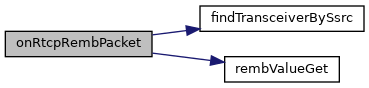
Here is the caller graph for this function:

◆ onRtcpTwccPacket()
| STATUS onRtcpTwccPacket | ( | PRtcpPacket | pRtcpPacket, |
| PKvsPeerConnection | pKvsPeerConnection ) |
Here is the call graph for this function:

Here is the caller graph for this function:

◆ parseRtcpTwccPacket()
| STATUS parseRtcpTwccPacket | ( | PRtcpPacket | pRtcpPacket, |
| PTwccManager | pTwccManager ) |
Here is the caller graph for this function:

◆ updateTwccHashTable()
| STATUS updateTwccHashTable | ( | PTwccManager | pTwccManager, |
| PINT64 | duration, | ||
| PUINT64 | receivedBytes, | ||
| PUINT64 | receivedPackets, | ||
| PUINT64 | sentBytes, | ||
| PUINT64 | sentPackets ) |
Here is the caller graph for this function:

