Amazon EC2 P6-B300 Instances Launch in APJ (Seoul and Hyderabad region)
Amazon EC2 P6-B300 instances, a next-generation GPU instance powered by eight NVIDIA Blackwell Ultra (B300) GPUs, have officially launched in Seoul region (ap-northeast-2) and Hyderabad region (ap-south-2) in August 2026. Compared with the previous-generation P5en (H200), P6-B300 delivers 1.9× the GPU memory (2.1TB), 1.6× the memory bandwidth (7.7 TB/s), and 2× the NVLink and EFA bandwidth, while adding FP4 precision — substantially improving the performance and token economics of AI training and inference workloads. AWS is the only major CSP to offer a B300 8-GPU configuration, and these APJ regions are among the first anywhere to provide P6-B300 outside US regions. APJ customers can now enjoy the benefits of the latest Blackwell GPUs from in-region data centers, meeting data residency requirements while minimizing latency for local users.
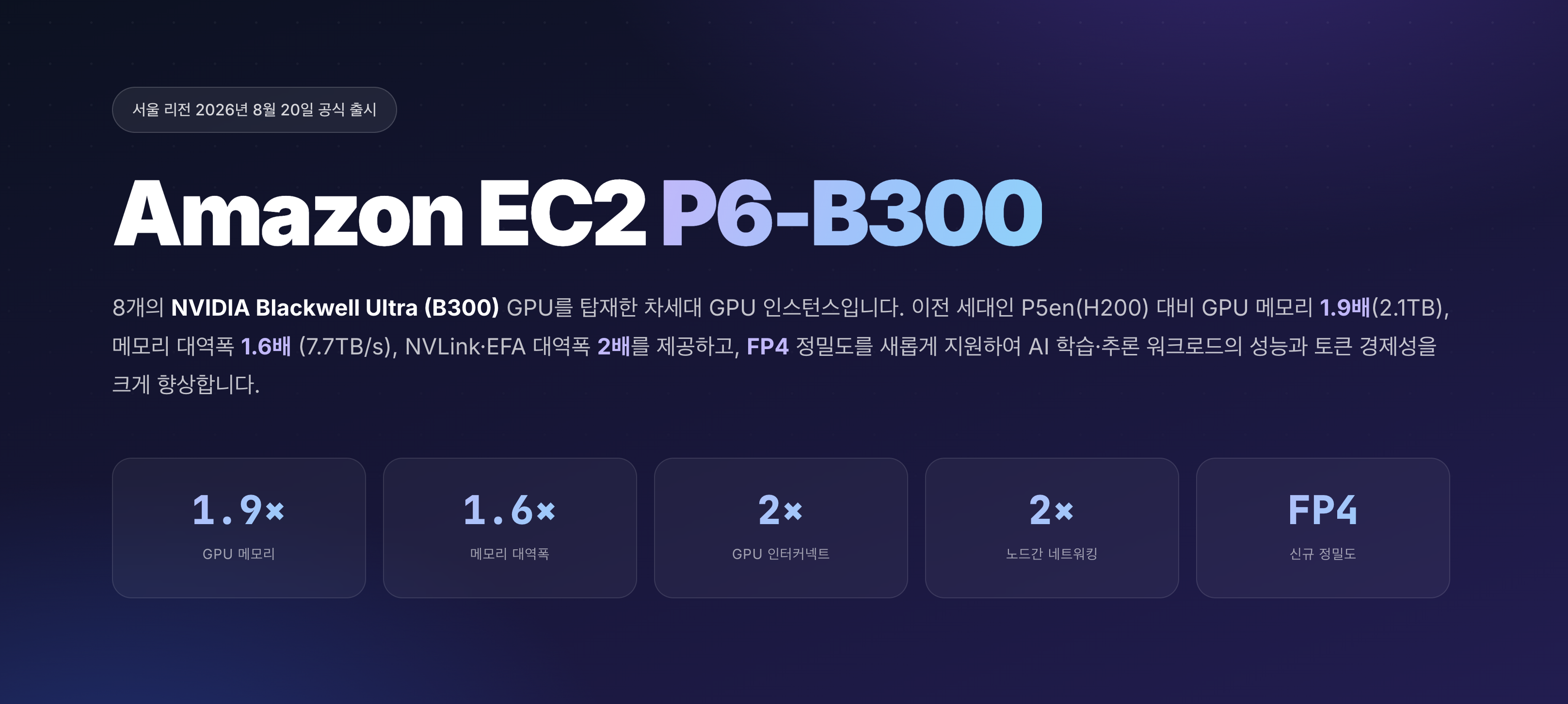
1. P6-B300 Key Highlights
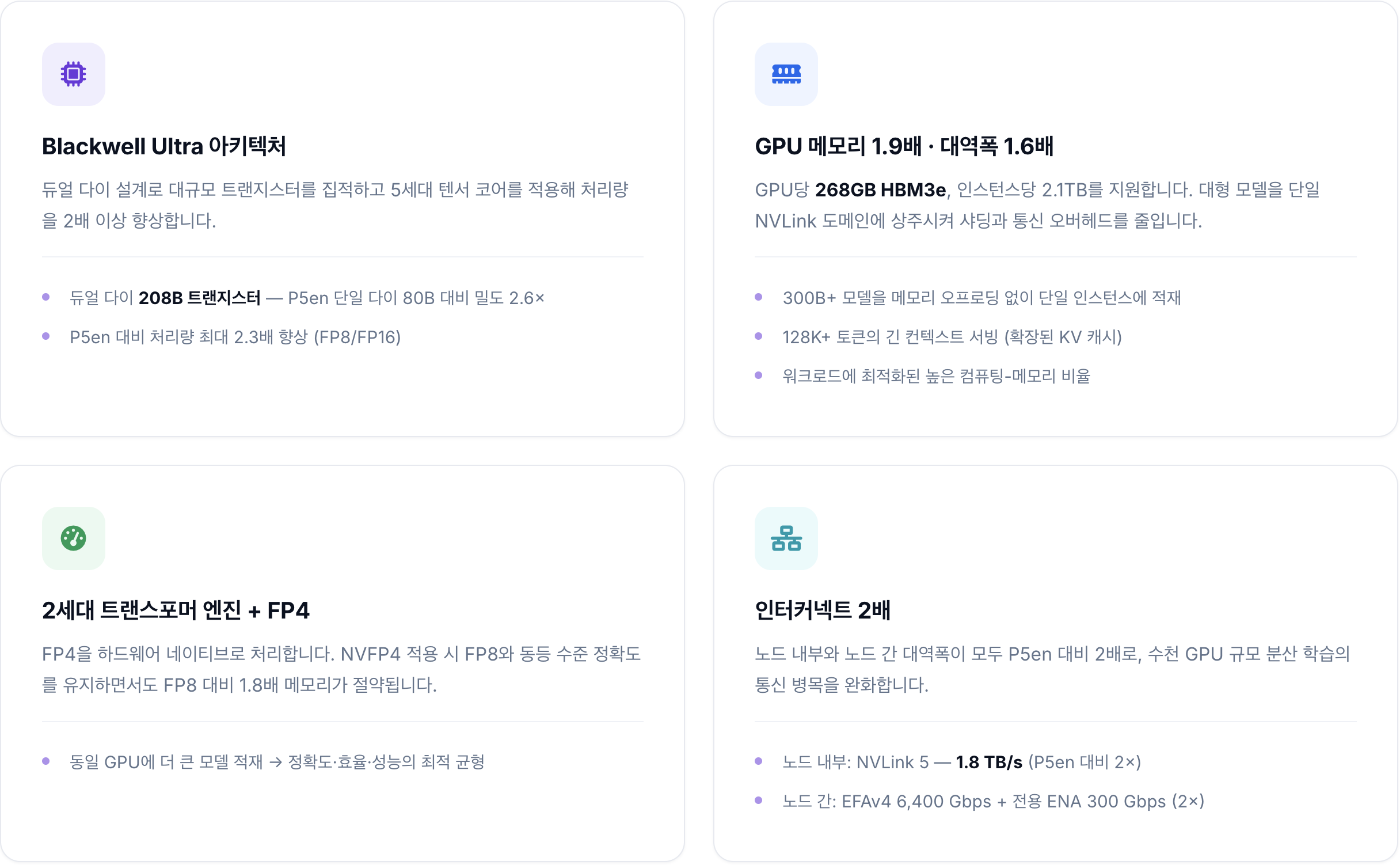
2. Key Specifications — Improvements vs the Previous Generation (P5en)
| Specification | P5en (H200) | P6-B300 (B300) | Improvement |
|---|---|---|---|
| Release | '24.12 | '25.11 | — |
| GPU | 8 × NVIDIA H200 | 8 × NVIDIA B300 (Blackwell Ultra) | — |
| Architecture | Hopper (single die, 80B) | Blackwell Ultra (dual die, 208B) | 2.6× transistors |
| GPU memory | 1,128 GB HBM3e (141GB/GPU) | 2,144 GB HBM3e (268GB/GPU) | 1.9× |
| Memory bandwidth | 4.8 TB/s | 7.7 TB/s | 1.6× |
| FP8/FP6 | 16 PFLOPS | 36 PFLOPS | 2.25× |
| FP4 | Not supported | 108 PFLOPS (without sparsity) / 144 PFLOPS (with sparsity) | New support |
| FP16/BF16 | 8 PFLOPS | 18 PFLOPS | 2.25× |
| NVLink | NVLink 4 — 900 GB/s | NVLink 5 — 1,800 GB/s | 2× |
| Networking | 3,200 Gbps (EFAv3) | 6,400 Gbps (EFAv4) + 300 Gbps dedicated ENA | 2× EFA, new dedicated ENA |
| CPU | Intel Sapphire Rapids | Intel Emerald Rapids | New CPU |
| System memory | 2 TB | 4 TB | 2× |
| Nitro System | Nitro v5 | Nitro v6 | Latest Nitro |
3. Ideal Use Cases
-
Large-scale inference serving
- Online inference optimization for 70B+ models (DeepSeek, Kimi series, and more)
- 100K+ tok/s throughput on a single GPU
- 268GB holds the entire KV cache, serving 128K+ contexts natively
- ~50% fewer GPUs · 40–60% ↓ latency
-
Multi-node large-scale training
- 400B+ parameter models
- Distributed training across thousands of GPUs with 6,400 Gbps EFAv4 + NVLink 5
- 2.1TB+ of GPU memory per instance serves a 400B model with ample batch and KV cache
- 2× communication bandwidth → higher scaling efficiency
4. Key Benefits for Training
The P6-B300's larger memory and higher bandwidth can reduce the number of GPUs needed for a given model, which in turn cuts infrastructure complexity — sharding strategy, distributed-training overhead, debugging, and more. FP8-native compute raises throughput 2–4× versus P5en, shortening training time and improving time-to-market.
Phase 1 — Built-in performance gains
- 4× higher compute: the dual-die design and 5th-gen Tensor Cores cut iteration time by ~50% at the same model and batch size.
- 2× GPU-to-GPU bandwidth: NVLink 5 delivers 1.8 TB/s of bidirectional bandwidth per GPU, relieving the network and storage bottlenecks inherent to tensor and pipeline parallelism.
- Enhanced AWS infrastructure: EFAv4 (6,400 Gbps), dedicated ENA (300 Gbps), and Nitro v6 (400 Gbps per NIC with RDMA support) keep data I/O from competing with training communication, minimizing GPU idle time.
Phase 2 — Gains from additional optimization
- GPU savings through memory optimization: 1.9× memory per GPU (H200 141GB → B300 268GB) lets you train the same model with half the GPUs — for a 70B model, multi-node FSDP can collapse to single-node DDP.
- FP8/FP4 quantization: hardware-native MXFP8 holds BF16-equivalent accuracy while delivering 2× throughput. NVFP4's 4× memory efficiency enables larger micro-batches, reducing gradient accumulation and raising throughput.
- Data-pipeline optimization (nvCOMP): a dedicated CPU→GPU hardware compression/decompression offload cuts I/O bottlenecks and checkpoint size by 20–30% each, speeding up experiment iteration and lowering FSx cost.
5. Key Benefits for Inference
- 1.6× memory bandwidth (4.8 → 7.7 TB/s): since decode performance scales with memory bandwidth, this lowers time-per-output-token (TPOT) and improves real-time responsiveness.
- 1.9× memory capacity (H200 141GB → B300 268GB/GPU): ~50% fewer GPUs per model and a lower TP degree remove GPU-to-GPU communication overhead, while a larger KV cache supports more concurrent sessions or longer contexts.
- NVFP4: ~4× memory savings versus FP16 and ~1.8× versus FP8, with accuracy on par with FP8 — and up to 50% less communication time in large prefill phases.
- NVLink 5 (900 → 1,800 GB/s): 2× the bandwidth for Expert Parallel (EP) all-to-all communication in MoE inference, lowering multi-GPU serving latency for large MoE models — and also easing TP AllReduce bottlenecks in dense models.
6. Why AWS
-
Expertise
- First to offer cloud GPU services, with the largest number of customer references worldwide
- A dedicated GPU team based in Korea
- Best practices for AI infrastructure design, operation, and optimization
- Over 15 years of collaboration with NVIDIA and the deepest joint software optimization
-
Performance
- Nitro System: dedicated hardware and a lightweight hypervisor remove virtualization overhead for bare-metal-class performance
- 3-tier storage configuration removes I/O bottlenecks and optimizes cost (Instance Store + FSx for Lustre + S3)
- Preconfigured Deep Learning AMIs/Containers shorten time-to-market and reduce operational burden
-
Reliability
- 99.99% uptime SLA
- Nitro security chip installed on the host motherboard, with complete isolation between VMs
- Lowest total downtime among major APAC clouds (per Frost & Sullivan, less than one-third of competitors)
-
Flexibility & Ecosystem
- The only major CSP to support a B300 8-GPU config (including in the Seoul region)
- The broadest instance portfolio, so you can choose the optimal chip and size for each workload
- A range of purchase options: On-Demand, Capacity Blocks, Spot, and more
- Native integration with 200+ AWS services (S3, FSx, EKS, CloudWatch, and more)
- Cost optimization through a GPU + Bedrock hybrid
- Optimized for the NVIDIA stack — DCGM Exporter, MIG, DRA, Run:ai, NIM, and more
- A rich open-source and partner ecosystem