TIFF Tile Codec
Version: 1.0
URI: https://awslabs.github.io/osml-imagery-io/codecs/tiff-tile
Codec type: array-to-bytes
Decodes compressed TIFF tiles into NumPy arrays. Supports LZW, JPEG, Deflate, Adobe Deflate, PackBits, CCITT Group 3/Group 4 fax, and uncompressed tiles, including horizontal differencing predictors, YCbCr-to-RGB conversion for JPEG tiles, and sub-byte (1/2/4-bit) sample unpacking for bilevel data and transparency masks.
Document Conventions
The key words “MUST”, “MUST NOT”, “SHOULD”, and “MAY” in this document are to be interpreted as described in RFC 2119.
Codec Identifier
The value of the name member in the codec metadata MUST be
https://awslabs.github.io/osml-imagery-io/codecs/tiff-tile.
Encoded Representation
The encoded representation MUST be a single compressed TIFF tile as it appears
in the TIFF file’s data area (the bytes referenced by a TileOffsets/TileByteCounts
entry). The compression format is determined by the compression configuration
parameter and MUST conform to the corresponding algorithm defined in TIFF
Revision 6.0 or the applicable TIFF Technical Note.
When compression is 7 (JPEG), the tile data MAY omit shared quantization and
Huffman tables, which MUST then be provided via the jpeg_tables configuration
parameter.
When the source image has PlanarConfiguration = 2 (planar), each tile in the
file’s data area holds the samples of a single band. The encoded
representation is therefore one such single-plane tile, and the configuration
MUST describe it as a single-band chunky tile — see
Planar source images.
Rationale: Why Compressed TIFF Tiles Need Metadata
Individual compressed tiles extracted from a TIFF file cannot be decoded in isolation. The compressed tile bytes are an opaque payload — the decoder needs IFD tag metadata (compression algorithm, predictor settings, photometric interpretation, JPEG quantization tables, etc.) that lives in the file header, not in the tile data itself. Without this metadata, the decoder cannot determine how to decompress the bytes or interpret the resulting pixel values.
This codec solves the problem by storing the required IFD tag values in its configuration. At decode time it constructs a minimal single-tile TIFF in memory from the configuration and the compressed tile bytes, then hands it to libtiff for decompression:
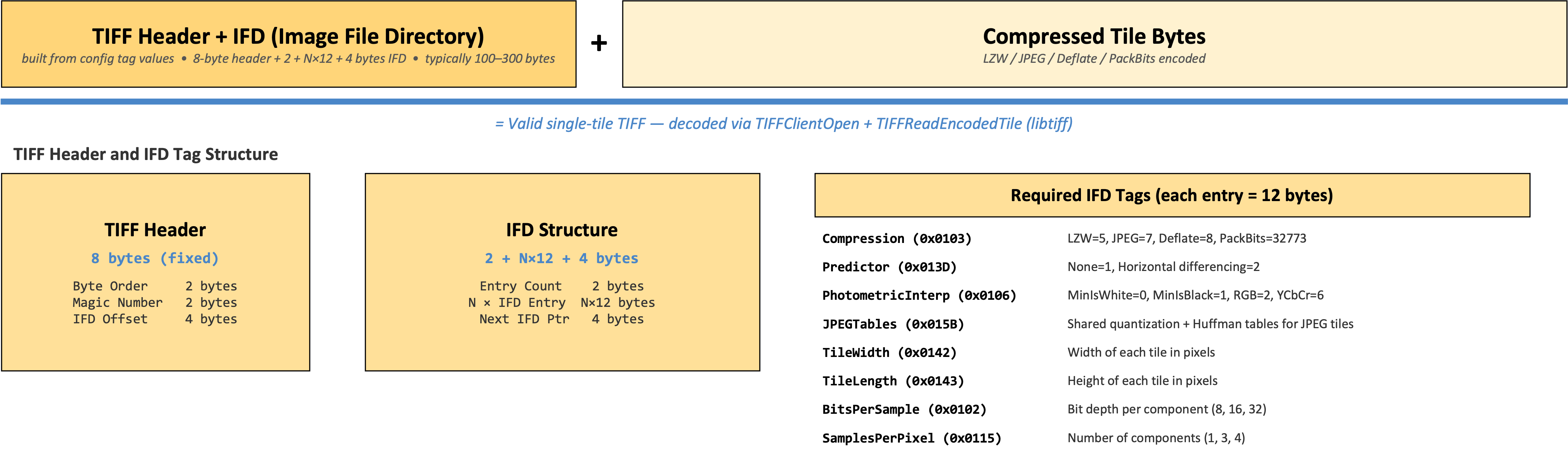
This approach delegates all decompression complexity (LZW, Deflate, JPEG, predictor reversal, byte-order conversion, color space conversion) to libtiff rather than reimplementing it. See the Synthetic Codestream Codec Pattern design document for further details.
Configuration Parameters
Field |
Type |
Required |
Default |
Description |
|---|---|---|---|---|
|
|
No |
|
TIFF compression tag value. See table below. |
|
|
No |
|
Bits per sample per band ( |
|
|
No |
|
Number of bands. |
|
|
No |
|
Photometric interpretation. |
|
|
No |
|
Planar configuration. |
|
|
No |
|
Differencing predictor. |
|
|
No |
|
Tile width in pixels. |
|
|
No |
|
Tile height in pixels. |
|
|
No |
|
Sample format. |
|
|
No |
|
Base64-encoded shared JPEG quantization and Huffman tables (TIFF tag 347). Required when |
Compression Tag Values
Value |
Name |
Notes |
|---|---|---|
|
None (uncompressed) |
Raw tile bytes; still needs byte-order conversion, and chunky-to-BSQ de-interleaving when |
|
CCITT Group 3 fax |
Bilevel (1-bit) encoding; decodes to sub-byte data unpacked to |
|
CCITT Group 4 fax |
Bilevel (1-bit) encoding; decodes to sub-byte data unpacked to |
|
LZW |
Supports horizontal differencing predictor ( |
|
JPEG |
Requires |
|
Deflate (zlib) |
Supports horizontal differencing predictor. |
|
PackBits |
Run-length encoding. |
|
Adobe Deflate |
Equivalent to Deflate; legacy tag value. |
Sample Format / Bits Per Sample to NumPy dtype Mapping
Sample Format |
Bits Per Sample |
NumPy dtype |
|---|---|---|
|
1, 2, 4 |
|
|
8 |
|
|
16 |
|
|
32 |
|
|
8 |
|
|
16 |
|
|
32 |
|
|
32 |
|
|
64 |
|
Planar Source Images
planar_config describes the layout of the chunk the codec is handed, not
necessarily the layout of the source file. For a multiband source image with
PlanarConfiguration = 2, each tile on disk carries one band’s samples, so the
Zarr view of that image uses a band-granular chunk grid: chunk_shape is
(1, tile_height, tile_width) and chunk keys are {band}.{row}.{col}, one chunk
per plane per tile position. Zarr stacks the resulting planes along the band
axis.
Every chunk in such an array is a complete, independently decodable single-plane
tile, so its codec configuration MUST carry samples_per_pixel = 1 and
planar_config = 1 — the chunk is presented to the decoder as a standalone
single-band chunky tile. Predictor semantics are preserved by construction: per
TIFF 6.0 Section 13, horizontal differencing on planar data operates per plane
exactly as it does on grayscale data, so no stride adjustment is needed.
Chunky source images (PlanarConfiguration = 1) are unaffected: one chunk holds
every band, chunk_shape is (samples_per_pixel, tile_height, tile_width), and
chunk keys are 0.{row}.{col}.
Band-granular chunking affects only the chunk grid, never the array’s logical
view. Both layouts declare the same shape of (bands, rows, columns), so array
indexing is unchanged and any selection yields a band-first array; Zarr stacks
the per-band chunks the same way it assembles a window spanning several spatial
chunks.
Algorithm
Decoding
Construct a minimal single-tile TIFF buffer in memory: an 8-byte TIFF header, an IFD containing the tag values from the codec configuration, and the compressed tile bytes appended after the IFD.
Open the buffer with libtiff’s
TIFFClientOpenusing memory-backed I/O callbacks.If
compression=7(JPEG) andphotometric=6(YCbCr), setJPEGCOLORMODE_RGBso libtiff performs YCbCr-to-RGB conversion during decode.Call
TIFFReadEncodedTile(handle, 0, ...)to decompress the tile. libtiff handles predictor reversal, byte-order conversion, and color space conversion internally.If
bits_per_sampleis sub-byte (1,2, or4), unpack the packed samples to oneuint8per sample. Unpacking is MSB-first and uses the tile’s per-row byte-boundary stride — not the image width — so partial edge tiles unpack correctly. Predictors are not defined for (nor emitted with) sub-byte data.If the decoded tile is smaller than the nominal tile dimensions (edge tile), pad with zeros to the full tile shape.
Convert from chunky (pixel-interleaved) to band-sequential (BSQ) format if
planar_config=1andsamples_per_pixel > 1. This step applies to uncompressed tiles (compression=1) as well as compressed ones — libtiff decompresses but does not reorder samples, so a multiband chunky tile arrives interleaved regardless of compression. Chunks from a planar source image reach this step withsamples_per_pixel = 1and are already band-sequential.Return an array with shape
(samples_per_pixel, tile_height, tile_width)and the dtype corresponding to thesample_format/bits_per_samplecombination.
Encoding
Encoding is not currently specified. See Implementation Notes.
Example Configuration
LZW with horizontal predictor
{
    "name": "https://awslabs.github.io/osml-imagery-io/codecs/tiff-tile",
    "configuration": {
        "compression": 5,
        "bits_per_sample": 8,
        "samples_per_pixel": 3,
        "photometric": 2,
        "planar_config": 1,
        "predictor": 2,
        "tile_width": 256,
        "tile_height": 256,
        "sample_format": 1
    }
}
One plane of a 3-band planar image
Each chunk of a band-granular array is a single-plane tile, so
samples_per_pixel is 1 and planar_config is 1 even though the source
image is 3-band planar. See Planar source images.
{
    "name": "https://awslabs.github.io/osml-imagery-io/codecs/tiff-tile",
    "configuration": {
        "compression": 5,
        "bits_per_sample": 8,
        "samples_per_pixel": 1,
        "photometric": 2,
        "planar_config": 1,
        "predictor": 2,
        "tile_width": 256,
        "tile_height": 256,
        "sample_format": 1
    }
}
References
TIFF Revision 6.0 — Tag Image File Format Specification
TIFF Technical Note #2 — TIFF Trees (JPEG-in-TIFF)
RFC 2119 — Key words for use in RFCs to Indicate Requirement Levels
Implementation Notes
aws.osml.io.zarr_codecs.TiffTileCodec — see API Reference.
Only the decode path is implemented. Calling encode() raises NotImplementedError.