Distributed Checkpointing: Save and Resume
In multi-node training, checkpointing is critical — jobs can be preempted, nodes can fail, and long-running pre-training runs must be resumable. DDP checkpointing has a few subtleties you need to handle correctly.
The Core Principle
Since DDP keeps all model replicas identical (thanks to AllReduce), you only need one rank to save the checkpoint. By convention, rank 0 writes; all ranks read when resuming.
Key Implementation Details
The full checkpoint save/load code is already integrated into the training script in the DDP script section. Here's a summary of the critical patterns:
- Always save both model AND optimizer state — optimizer state (momentum, adaptive LR terms) is essential for consistent resume.
- Use
model.module.state_dict()— unwraps the DDP wrapper to save clean weights. - Atomic saves — write to a temp file, then
os.rename()to prevent corruption if interrupted mid-write. - Symlink to latest — makes resume logic simple (
checkpoint_latest.ptalways points to the last good save). map_location— when loading, map tensors to the correct GPU:map_location=f"cuda:{local_rank}".- Barriers —
dist.barrier()before and after save to ensure all ranks are synchronized.
Using torch.distributed.checkpoint (DCP) — The Modern Approach
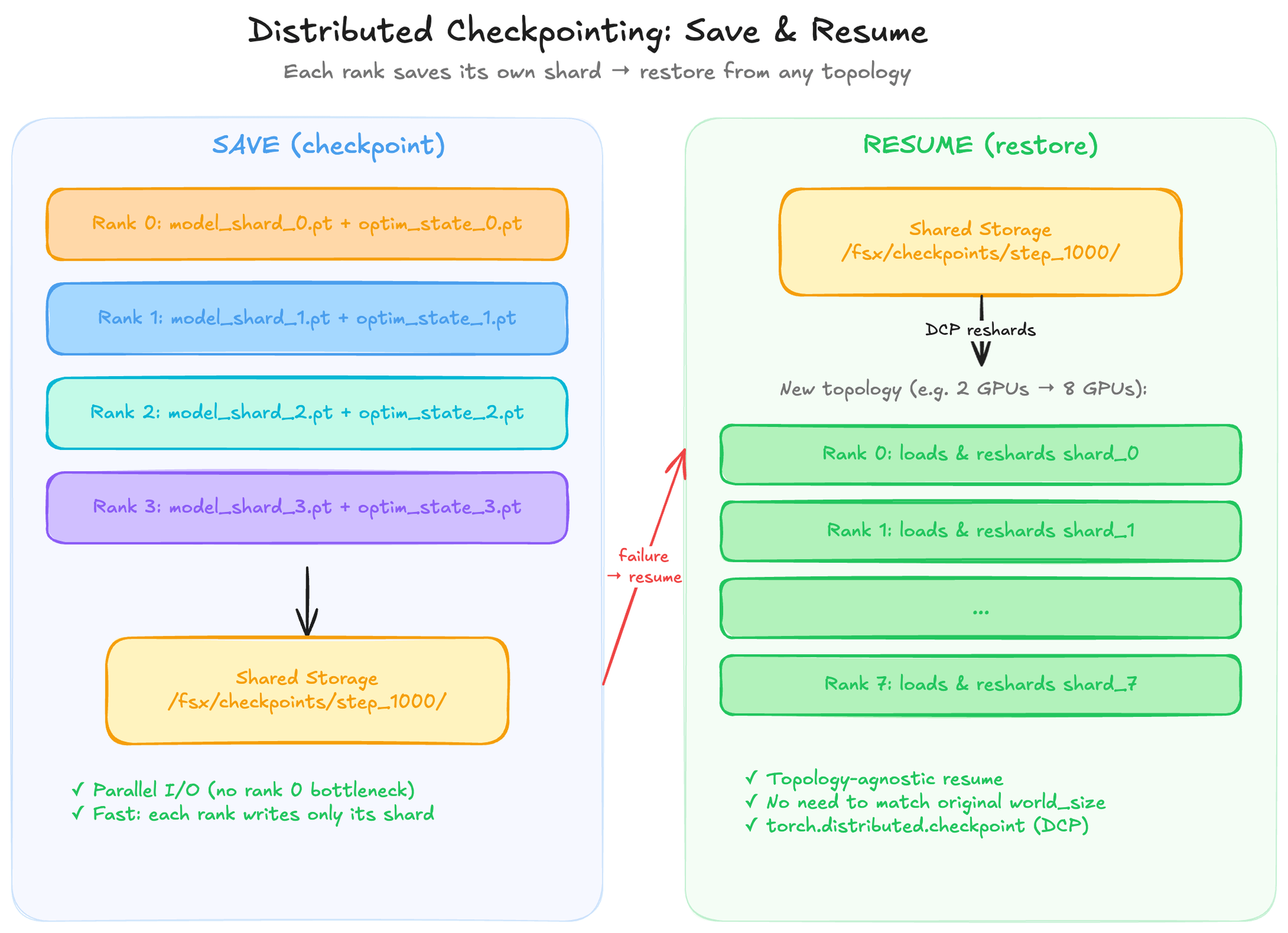
Figure 4: With DCP, every rank writes its own shard in parallel and the checkpoint is resharded on resume.
For larger runs, PyTorch provides torch.distributed.checkpoint (DCP) which supports async saves and sharded checkpoints (essential for FSDP, but also useful with DDP for faster I/O):
import torch.distributed.checkpoint as dcp
from torch.distributed.checkpoint.state_dict import get_state_dict, set_state_dict


def save_checkpoint_dcp(model, optimizer, checkpoint_dir):
    """Save using DCP — all ranks participate, writes sharded files in parallel."""
    model_state, optimizer_state = get_state_dict(model, optimizer)

    state_dict = {
        "model": model_state,
        "optimizer": optimizer_state,
    }

    dcp.save(state_dict, checkpoint_id=checkpoint_dir)


def load_checkpoint_dcp(model, optimizer, checkpoint_dir):
    """Load using DCP — all ranks read their shard in parallel."""
    model_state, optimizer_state = get_state_dict(model, optimizer)

    state_dict = {
        "model": model_state,
        "optimizer": optimizer_state,
    }

    dcp.load(state_dict, checkpoint_id=checkpoint_dir)
    set_state_dict(model, optimizer, model_state_dict=state_dict["model"],
                   optim_state_dict=state_dict["optimizer"])
When to use DCP vs.
torch.save:
- Use
torch.save(rank 0 only) for small-to-medium models — simpler, single file, easy to inspect.- Use DCP for large models or when checkpoint I/O becomes a bottleneck — all ranks write in parallel, reducing save time proportionally to world size.