Understanding DataLoaders in DDP
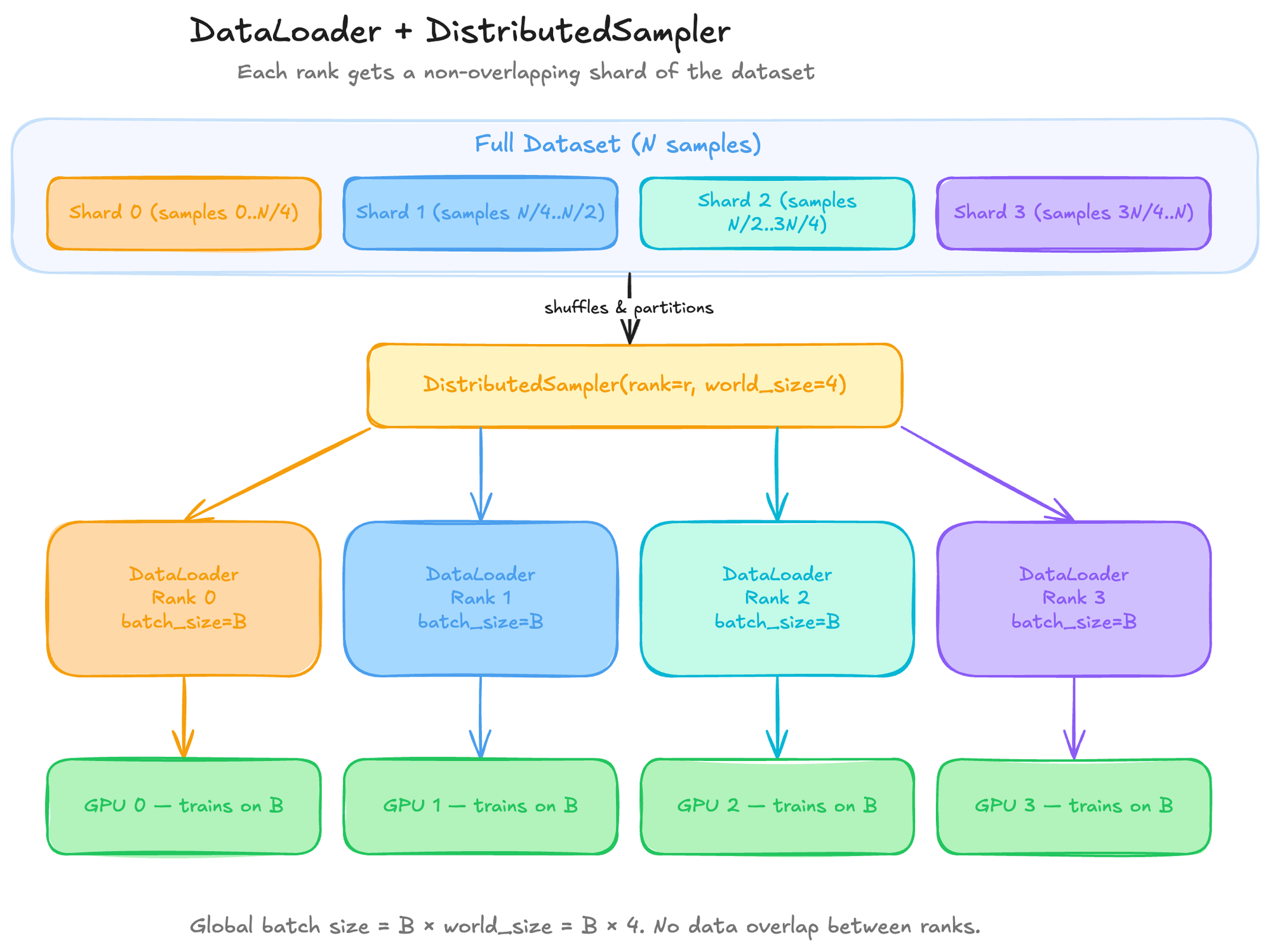
Figure 3: DistributedSampler partitions the dataset into non-overlapping shards — one per GPU.
How PyTorch DataLoader Works
A DataLoader wraps a Dataset and provides:
- Batching — groups samples into mini-batches.
- Shuffling — randomizes the order each epoch.
- Prefetching — loads the next batch in background workers while the GPU trains.
from torch.utils.data import DataLoader, Dataset

loader = DataLoader(
    dataset,
    batch_size=32,
    shuffle=True,
    num_workers=4,       # parallel data loading workers
    pin_memory=True,     # faster CPU → GPU transfer
    prefetch_factor=2,   # batches prefetched per worker
)
The Problem: Duplicate Data in Multi-GPU
If every GPU creates a DataLoader with shuffle=True, each GPU shuffles independently — they may see overlapping samples within an epoch. This wastes computation and breaks the statistical guarantee that every sample is seen exactly once per epoch.
The Solution: DistributedSampler
DistributedSampler partitions the dataset into world_size non-overlapping shards. Each rank only sees its own shard:
from torch.utils.data import DataLoader, DistributedSampler

sampler = DistributedSampler(
    dataset,
    num_replicas=world_size,  # total GPUs
    rank=rank,                # this process's ID
    shuffle=True,
)

loader = DataLoader(
    dataset,
    batch_size=32,
    sampler=sampler,          # replaces shuffle=True
    num_workers=4,
    pin_memory=True,
    prefetch_factor=2,
)
Important: When using a DistributedSampler, do not pass shuffle=True to DataLoader — shuffling is handled by the sampler. You must also call sampler.set_epoch(epoch) at the start of each epoch to ensure different shuffling across epochs.
Effective Batch Size — The Most Important Equation
When using DDP, your effective batch size increases proportionally to the number of GPUs:
effective_batch_size = batch_size_per_gpu × world_size × accumulation_steps
Example: batch_size_per_gpu=4, world_size=16 (2 nodes × 8 GPUs), accumulation_steps=2:
effective_batch_size = 4 × 16 × 2 = 128
This matters because:
- Larger effective batch sizes require learning rate scaling (see the DDP script section).
- You should decide your target effective batch size first, then work backward to choose
batch_size_per_gpuandaccumulation_steps.
DataLoader Performance Tips for Multi-Node
| Tip | Why |
|---|---|
num_workers=4 (or CPUs_per_GPU) | Keeps the GPU fed; too many workers waste memory |
pin_memory=True | Enables async CPU→GPU copies |
persistent_workers=True | Avoids re-spawning workers each epoch |
prefetch_factor=2 | Balances memory vs. latency hiding |
Use drop_last=True | Avoids an uneven final batch that would stall AllReduce |