Network Architecture
VAMS supports multiple network deployment configurations to accommodate commercial AWS, AWS GovCloud, and the AWS European Sovereign Cloud. This page describes the network topology for each deployment mode, VPC configuration options, VPC endpoints, and subnet architecture.
Deployment Modes
Amazon CloudFront Deployment (Commercial AWS)
The default deployment mode uses Amazon CloudFront as the global content delivery network for both the web application and API requests.
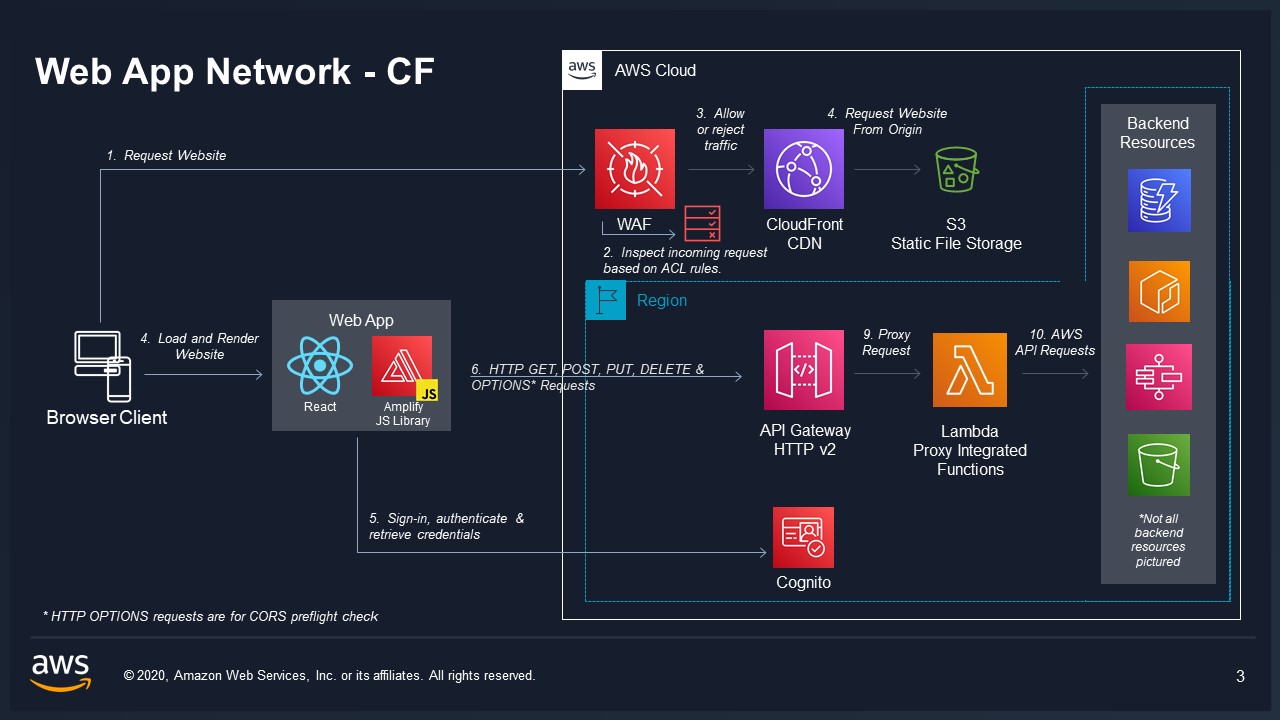
In this mode:
- Amazon CloudFront serves the React web application from an Amazon S3 origin bucket
- API requests are proxied through Amazon CloudFront to the REST API, with CloudFront's
/api/*behavior using an originPath of/api(the REST API stage) to absorb the stage path - When AWS WAF is enabled, a
CLOUDFRONT-scoped Web ACL (deployed inus-east-1) protects the distribution, and a separate regional Web ACL protects the API Gateway stage (see WAF Protection Scope) - Custom domain names are supported via
useCloudFront.customDomainconfiguration with an AWS Certificate Manager certificate and optional Amazon Route 53 hosted zone - The API endpoint type is configurable:
REGIONAL(default, public; not routed through any VPC endpoint) orPRIVATE(VPC interface endpoint only, incompatible with CloudFront)
Application Load Balancer Deployment (GovCloud / ALB Mode)
For AWS GovCloud or environments requiring an Application Load Balancer, VAMS deploys an ALB as the entry point.
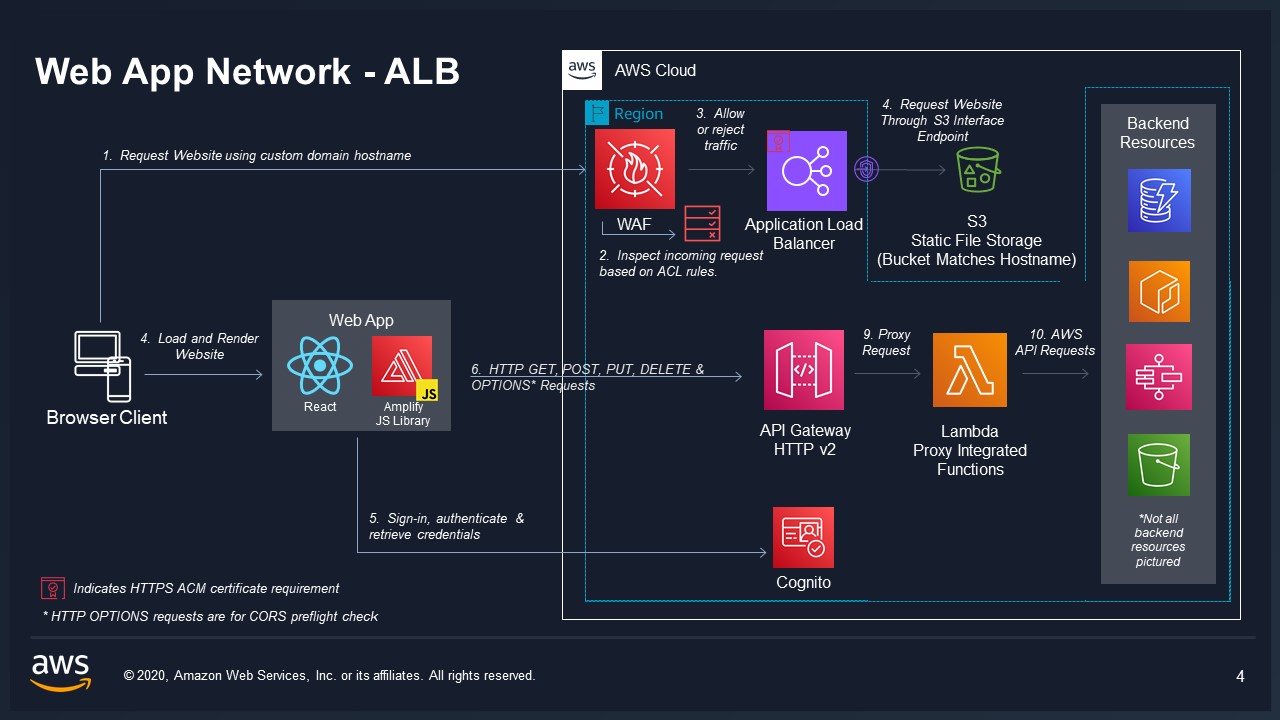
In this mode:
- An Application Load Balancer serves the web application and proxies API requests
- The ALB requires a domain host name and an AWS Certificate Manager certificate ARN
- The ALB redirects
/api*and/secure-config*paths by prepending/api(the REST API stage) to absorb the stage path - The ALB can be deployed in public subnets (
useAlb.usePublicSubnet = true) or isolated subnets (useAlb.usePublicSubnet = false) - When AWS WAF is enabled, a single regional Web ACL protects both the ALB and the API Gateway stage
- VPC is required (
useGlobalVpc.enabled = true) - A dedicated Amazon S3 interface VPC endpoint forwards static web file requests from the ALB to the Amazon S3 web-app bucket (see ALB Amazon S3 interface endpoint)
- The API endpoint type is configurable:
REGIONAL(public; not routed through any VPC endpoint) orPRIVATE(VPC interface endpoint only)
VPC-Isolated Deployment (GovCloud)
For restricted environments, GovCloud and AWS European Sovereign Cloud deployments can use full VPC isolation with all AWS service access routed through VPC endpoints and no internet egress. This full-isolation topology applies when useGlobalVpc.useForAllLambdas is true, which places every VAMS Lambda function inside the VPC. The GovCloud and European Sovereign Cloud templates set useForAllLambdas to false by default — only the Lambda functions that require the VPC run inside it — and you set it to true when stricter network isolation is needed or the Lambda functions must reach specific VPC network components.
REST API Endpoint Types and Access Control
VAMS uses an Amazon API Gateway REST API with configurable endpoint types that control network access to the backend.
Endpoint Type Configuration
| Endpoint Type | Configuration | Network Access | Compatible Distributions |
|---|---|---|---|
REGIONAL | app.api.apiGatewayRest.endpointType | Publicly addressable. Does not route through any VPC endpoint, even when a VPC and its endpoints are enabled. | CloudFront or ALB |
PRIVATE | app.api.apiGatewayRest.endpointType | Reachable only through an execute-api VPC interface endpoint. Requires useGlobalVpc.enabled and either useGlobalVpc.addVpcEndpoints = true (VAMS creates the endpoint) or optionalExternalPrivateApigVPCEId set. | ALB only (not CloudFront) |
A PRIVATE API endpoint is incompatible with Amazon CloudFront, which cannot reach a private API. When deploying with endpointType: "PRIVATE", you must front it with the ALB (useCloudFront.enabled = false, useAlb.enabled = true), and that ALB must run in isolated (non-public) subnets (useAlb.usePublicSubnet = false) — a public-subnet ALB would expose an internet-facing path to the private API. Configuration validation enforces useGlobalVpc.enabled = true, the ALB requirements, and that an execute-api endpoint is available — either created by VAMS (useGlobalVpc.addVpcEndpoints = true) or supplied through app.api.apiGatewayRest.optionalExternalPrivateApigVPCEId.
Stage Path Fronting
The REST API deployment stage is named api (a fixed internal value, not a configuration option) and is absorbed by the web distribution fronting layer so that client requests use clean /api/* paths:
- CloudFront: The
/api/*behavior usesoriginPath: "/api", mappinghttps://example.com/api/versionto the stage's invoke URL athttps://{restApiId}.execute-api.{region}.amazonaws.com/api/version. - ALB: The listener redirects
/api*and/secure-config*paths by prepending/api, mappinghttps://example.com/api/versionto the same stage invoke URL.
This keeps the browser/CLI base URL unchanged (/api/version). The stage name is shared with the VamsCLI endpoint constants, so it is fixed in the codebase rather than configurable.
WAF Protection Scope
When AWS WAF is enabled (app.useWaf = true), VAMS always creates a regional Web ACL in the deployment Region and associates it with the API Gateway stage — for both REGIONAL and PRIVATE endpoint types. The API's execute-api endpoint stays directly reachable in every fronting configuration (CloudFront and the ALB proxy /api/*, but neither replaces direct API access), so protecting the API stage itself closes a path that fronting alone does not cover.
The web distribution determines whether a second Web ACL is also created:
- CloudFront deployment: A
CLOUDFRONT-scoped Web ACL (deployed inus-east-1) protects the distribution, and the regional Web ACL protects the API Gateway stage. Two Web ACLs are required because AWS WAF does not allow a CloudFront-associated Web ACL to be shared with any other resource type, and API Gateway requires a regional-scoped Web ACL in the deployment Region. This holds even when the deployment Region isus-east-1. - ALB deployment (without CloudFront): A single regional Web ACL protects both the REST API stage and the ALB.
- No CloudFront or ALB: The regional Web ACL protects the API Gateway stage.
Both Web ACLs (when two exist) are built from the same config/policy/wafPolicyConfig.json rule policy. This ensures every request is filtered by WAF at the entry point, whether it arrives through CloudFront, through the ALB, or directly against the API Gateway endpoint. Within that policy, the AWS Common Rule Set runs eight rules in count (non-blocking) mode through per-rule ruleActionOverrides entries, each matching an ordinary VAMS request shape the backend already validates: SizeRestrictions_BODY (request bodies up to the API Gateway REST maximum of 10 MB, such as multi-part upload requests), SizeRestrictions_QUERYSTRING (long query strings — the SuperSplat viewer passes a presigned Amazon S3 URL in a ?load= parameter, which exceeds the rule's 2048-byte threshold), SizeRestrictions_URIPATH (URL-encoded asset file keys over 1024 bytes on the file stream routes), RestrictedExtensions_URIPATH and RestrictedExtensions_QUERYARGUMENTS (file names with configuration-style extensions such as .log or .ini that the backend upload blocklist admits), and GenericLFI_URIPATH, GenericLFI_QUERYARGUMENTS, and GenericLFI_BODY (encoded ../ sequences, which every backend path validator rejects). The rest of the managed rules continue to block. The per-rule rationale is in the configuration reference.
VPC Configuration Options
VAMS supports three VPC modes:
| Mode | Configuration | Description |
|---|---|---|
| No VPC | useGlobalVpc.enabled = false | Default for commercial. Lambda functions run outside VPC. |
| VAMS-Managed VPC | useGlobalVpc.enabled = true, no optionalExternalVpcId | VAMS creates a new VPC with configured CIDR range. |
| External VPC Import | useGlobalVpc.enabled = true + optionalExternalVpcId | VAMS imports an existing VPC and specified subnets. |
VAMS-Managed VPC Configuration
When VAMS creates its own VPC, the following subnet types are provisioned:
| Subnet Type | CIDR Mask | Purpose | Always Created |
|---|---|---|---|
Isolated (PRIVATE_ISOLATED) | /23 (510 usable IPs) | Lambda functions, VPC endpoints | Yes |
Private (PRIVATE_WITH_EGRESS) | /26 (62 usable IPs) | Pipeline compute (AWS Batch with NAT Gateway) | Conditional |
| Public | /26 (62 usable IPs) | ALB, pipeline compute requiring internet | Conditional |
Private and public subnets are created when any of the following are enabled:
- ALB with public subnet (
useAlb.usePublicSubnet) - RapidPipeline ECS or EKS
- ModelOps pipeline
- Splat Toolbox pipeline
- Isaac Lab Training pipeline
- NVIDIA Cosmos pipeline (Predict, Reason, or Transfer)
- NVIDIA Gr00t pipeline
Availability Zone Configuration
VAMS provisions a fixed number of Availability Zones for every subnet type it creates. The isolated subnets are always created across this AZ count, and the conditional private and public subnets (when created) use the same count. Keeping the AZ count stable across feature toggles avoids subnet add/remove churn between deployments.
| Condition | AZ Count |
|---|---|
| Amazon OpenSearch Service (Provisioned) | availabilityZoneCount (2 or 3, default 2) |
| All other configurations (baseline) | 2 AZs |
When Amazon OpenSearch Service (Provisioned) is enabled, the AZ count follows openSearch.useProvisioned.availabilityZoneCount (2 or 3, default 2), with one data node per zone. At 2 the domain runs zone-aware without Standby (two data nodes, single index copy). At 3 the domain runs as Multi-AZ with Standby (three data nodes, and the asset/file indexes are created with two replicas so each has three copies, which Standby requires). Set it to 2 for Regions or partitions that expose only two Availability Zones, such as the AWS European Sovereign Cloud Region eusc-de-east-1; the configuration validation rejects an availabilityZoneCount greater than 2 for that Region.
Multi-AZ with Standby requires every index to have copies in a multiple of three. VAMS creates the indexes with the correct replica count for the chosen Availability Zone count, but a 3-AZ Standby domain must be created fresh — switching an existing 2-AZ (single-copy) domain to availabilityZoneCount: 3 in place is rejected by Amazon OpenSearch Service, because the domain configuration is validated against the existing indexes before their replica count can change. To move an existing domain to 3-AZ Standby, deploy with OpenSearch disabled to remove the domain, then re-enable it with availabilityZoneCount: 3 to create a fresh domain, and run the reindex tool to repopulate it.
The number of primary shards per index is set by openSearch.useProvisioned.numberOfShards (default 1). As a sizing guideline, an index expected to exceed roughly 60 GB — about 3 million asset or file records for VAMS — should use more than one shard. Like the replica count, the shard count is fixed at index creation: changing it requires re-creating the index (disable and re-enable OpenSearch, then reindex); existing indexes are not re-sharded in place.
External VPC Import
When importing an existing VPC, subnet IDs must be provided for each subnet type:
| Configuration | Description |
|---|---|
optionalExternalVpcId | VPC ID to import |
optionalExternalIsolatedSubnetIds | Comma-separated isolated subnet IDs |
optionalExternalPrivateSubnetIds | Comma-separated private subnet IDs |
optionalExternalPublicSubnetIds | Comma-separated public subnet IDs |
When importing a VPC, you may need to run an initial cdk synth with loadContextIgnoreVPCStacks = true to populate the CDK context with VPC metadata before the full deployment.
VPC Endpoints
When useGlobalVpc.addVpcEndpoints = true, VAMS creates VPC endpoints to enable AWS service access from isolated subnets without internet connectivity.
When useGlobalVpc.addVpcEndpoints = false (operator-created endpoints) with useForAllLambdas = true, the AWS Systems Manager (SSM) interface endpoint must exist in the VPC. Every VAMS Lambda function resolves its DynamoDB table, S3 bucket, and audit log group names from SSM Parameter Store at cold start and fails to initialize without a path to SSM.
Gateway Endpoints (No Cost)
These gateway endpoints are always created when VPC endpoints are enabled:
| Endpoint | Service | Subnets |
|---|---|---|
| Amazon S3 | GatewayVpcEndpointAwsService.S3 | Isolated |
| Amazon DynamoDB | GatewayVpcEndpointAwsService.DYNAMODB | Isolated |
Common Interface Endpoints
These interface endpoints are always created when VPC endpoints are enabled:
| Endpoint | Service | Purpose |
|---|---|---|
| Execute-API | EXECUTE_API | REST API invoke access for a PRIVATE endpoint. Created only when endpointType="PRIVATE" and useGlobalVpc.addVpcEndpoints is true. A REGIONAL endpoint is public and does not use it. |
| AWS Systems Manager (SSM) | SSM | Parameter Store access. Required by every VAMS Lambda function, which resolves DynamoDB table, S3 bucket, and audit log group names from Parameter Store at cold start. |
| AWS Lambda | LAMBDA | Lambda-to-Lambda invocations |
| AWS STS | STS | Credential federation |
| Amazon CloudWatch Logs | CLOUDWATCH_LOGS | Log delivery |
| AWS Step Functions | STEP_FUNCTIONS | Workflow execution |
| Amazon EventBridge | EVENTBRIDGE | Orchestration bus access (events). In-VPC Lambdas publish and consume events on the workflow orchestration bus — file-upload trigger dispatch and pipeline sub-process registration. |
| Amazon SNS | SNS | Event notifications |
| Amazon SQS | SQS | Queue operations |
| AWS Secrets Manager | SECRETS_MANAGER | Secret retrieval. Used by add-on Lambda functions that hold third-party credentials and by the pipeline container execution roles that inject access tokens into AWS Batch jobs. |
The execute-api interface VPC endpoint (com.amazonaws.{region}.execute-api) is created only for a PRIVATE REST API — that is, when endpointType="PRIVATE" and useGlobalVpc.addVpcEndpoints is true. A PRIVATE endpoint is reachable only through it (or through an operator-supplied endpoint via optionalExternalPrivateApigVPCEId). A REGIONAL endpoint is publicly addressable and does not route through any execute-api VPC endpoint, even when a VPC and its endpoints are enabled.
The AWS Secrets Manager interface VPC endpoint (com.amazonaws.{region}.secretsmanager) is part of the common endpoint set: it is created for every deployment with useGlobalVpc.addVpcEndpoints = true, independently of which add-ons and pipelines are enabled. Because it is created with privateDnsEnabled: true, it carries every in-VPC AWS Secrets Manager call, including the AWS Batch pipeline task execution roles that read a third-party access token from a secret. Only the standard endpoint is created; VAMS Lambda functions and task execution roles resolve the default regional AWS Secrets Manager endpoint rather than the secretsmanager-fips variant, so no FIPS endpoint is created when useFips = true.
The Physna Sync add-on (app.addons.usePhysnaSync.enabled) calls the Physna software as a service API and its authorization token endpoint over the public internet. The AWS Secrets Manager endpoint covers the add-on's credential retrieval, but there is no VPC endpoint for a third-party service, so the add-on's Lambda functions need an outbound internet path. With useGlobalVpc.useForAllLambdas = true those functions run in the isolated subnets, which have no egress, and every Physna API call fails. Enable the add-on only in a VPC that provides egress to the Physna endpoints — for example, an imported VPC (optionalExternalVpcId) whose optionalExternalIsolatedSubnetIds name subnets with a NAT gateway route, or a deployment left at useForAllLambdas = false so the add-on's Lambda functions run outside the VPC. Configuration validation does not reject the combination, so it is a deployment-planning consideration rather than a synth-time error.
Conditional Interface Endpoints
These non-pipeline endpoints are created based on the deployment configuration:
| Endpoint | Condition | Purpose |
|---|---|---|
| AWS KMS | useKmsCmkEncryption.enabled | KMS key operations |
| AWS KMS (FIPS) | useKmsCmkEncryption.enabled + useFips | FIPS-compliant KMS |
| Amazon S3 (ALB web) | ALB mode + useAlb.addAlbS3SpecialVpcEndpoint | ALB-to-S3 static web file serving |
| AWS Deadline Cloud | pipelines.deadlineCloudExecutionTypeEnabled + useGlobalVpc.useForAllLambdas | deadline.management — read a job's status and cancel a farm job. AWS Deadline Cloud is unavailable in GovCloud / EU Sovereign, so the execution type (and this endpoint) cannot be enabled there. |
VAMS does not create Amazon Cognito interface endpoints. See MFA-Aware Roles for what that means for Lambda functions running in the VPC.
In Application Load Balancer deployment mode, VAMS creates a dedicated Amazon S3 interface VPC endpoint (separate from the S3 gateway endpoint above) so the ALB can forward requests for the React web application to the Amazon S3 web-app bucket. This endpoint is created by the static web construct (not the VPC builder) and differs from the common interface endpoints in several ways:
- It is gated by
useAlb.addAlbS3SpecialVpcEndpoint(defaulttrue) and is created independently ofuseGlobalVpc.addVpcEndpoints— it exists whenever ALB mode is used, because the ALB listener/target group depends on it. SetaddAlbS3SpecialVpcEndpointtofalseonly when the endpoint already exists in your VPC (for example, when it must be created manually outside the stack). - It is created with
privateDnsEnabled: falseand placed in the ALB (web app) subnets rather than the isolated subnets. - Its endpoint policy restricts access to the specific web-app Amazon S3 bucket (
s3:Get*,s3:List*), and a Lambda-backed custom resource registers the endpoint's network interface IPs as ALB targets. :::
OpenSearch Serverless Interface Endpoint
A private Amazon OpenSearch Serverless collection (openSearch.useServerless.allowPublic = false) is reached only through a VPC endpoint into which the OpenSearch-facing Lambda functions (search and indexers) connect. The endpoint is created by the OpenSearch Serverless construct (not the VPC builder) and is placed in the isolated subnets across two Availability Zones.
The endpoint type is determined by the collection generation, because the two generations expose different collection endpoint hostnames:
| Generation | Collection hostname | VPC endpoint |
|---|---|---|
Next-generation (nextGen=true) | {collection-id}.aoss.{region}.on.aws | Standard AWS PrivateLink interface endpoint (ec2.InterfaceVpcEndpoint, service com.amazonaws.{region}.aoss-data), privateDnsEnabled: true |
Classic (nextGen=false) | {collection-id}.{region}.aoss.amazonaws.com | Amazon OpenSearch Serverless-managed endpoint (CfnVpcEndpoint), which provisions its own Amazon Route 53 private hosted zone |
VAMS creates the correct endpoint type for the configured generation. The in-VPC Lambda functions connect over private DNS on port 443 using SigV4 signing with service name aoss. The endpoint's id is added to the collection's network access policy (SourceVPCEs).
The next-generation endpoint is a standard Amazon EC2 interface endpoint, so it follows the global useGlobalVpc.addVpcEndpoints setting like every other interface endpoint. The classic managed endpoint is an Amazon OpenSearch Serverless resource rather than an Amazon EC2 interface endpoint, so it is not governed by addVpcEndpoints and is always created for a private classic collection.
| Generation | addVpcEndpoints | VAMS creates endpoint + network policy? |
|---|---|---|
| NextGen | true | Yes |
| NextGen | false | No — deferred to manual creation |
| Classic | true or false | Yes (managed endpoint, not governed by the flag) |
addVpcEndpoints=falseWhen a private next-generation collection is deployed with useGlobalVpc.addVpcEndpoints = false, VAMS does not create the aoss-data interface endpoint or the collection's VPC network access policy — both must be created manually after deployment. The deployment still succeeds (the OpenSearch SSM parameters are written and index creation is skipped). For the step-by-step procedure to create the endpoint, tie it to the collection through a network access policy, deploy the deferred index schema, and populate the indexes, see OpenSearch — deferred next-gen setup.
When VAMS creates the OpenSearch Serverless VPC endpoint, it uses its own security group (separate from the common VPC endpoint security group described below), allowing inbound HTTPS (port 443) from the VPC CIDR. Each OpenSearch-facing Lambda's security group is additionally granted inbound access on the endpoint.
Pipeline Interface Endpoints
VPC-requiring pipelines (AWS Batch Fargate and GPU pipelines) create their own interface endpoints — a shared set of AWS Batch, Amazon ECR API, and Amazon ECR Docker whenever any AWS Batch pipeline is enabled, plus additional per-pipeline endpoints (Amazon ECS, Amazon ECS Agent, Amazon ECS Telemetry, Amazon EFS, Amazon Bedrock Runtime, Amazon Rekognition) depending on which pipelines are enabled.
The authoritative per-pipeline endpoint matrix lives with the pipeline documentation. See Pipeline System Overview — VPC and Network Requirements for the full chart of which interface endpoints each pipeline requires.
Security Groups
VPC Endpoint Security Group
A single security group is created for all VPC endpoints with the following rules:
| Direction | Protocol | Port | Source | Purpose |
|---|---|---|---|---|
| Ingress | TCP | 443 | VPC CIDR | HTTPS access to endpoints |
| Ingress | TCP | 53 | VPC CIDR | DNS resolution for ECR |
| Ingress | UDP | 53 | VPC CIDR | DNS resolution for ECR |
| Egress | All | All | 0.0.0.0/0 | Allow all outbound |
Pipeline Security Groups
Each pipeline construct creates its own security group with VPC CIDR-based ingress rules for communication between AWS Batch compute environments and VPC endpoints.
VPC Flow Logs
When VAMS creates a managed VPC, VPC flow logs are automatically enabled:
| Setting | Value |
|---|---|
| Destination | Amazon CloudWatch Logs |
| Traffic Type | ALL |
| Log Group | /aws/vendedlogs/VAMSCloudWatchVPCLogs-{hash} |
| Retention | 1 year |
The retention period comes from the LogRetentionAspect CDK aspect, which sets it on every CloudWatch log group in the stack and overwrites any value declared on an individual construct. Change it for the whole deployment at the single new LogRetentionAspect(...) call site in infra/lib/core-stack.ts — see Configuring Log Retention.
DNS Configuration
Interface VPC endpoints are created with privateDnsEnabled: true. This allows Lambda functions and containers within the VPC to use standard AWS service hostnames (e.g., dynamodb.us-east-1.amazonaws.com) without custom DNS configuration. The VPC endpoint private DNS automatically resolves these hostnames to the endpoint's private IP addresses. The same applies to the standard OpenSearch Serverless next-generation endpoint, which resolves the *.aoss.{region}.on.aws collection hostnames through private DNS. The two exceptions are the ALB Amazon S3 interface endpoint (created with privateDnsEnabled: false) and the OpenSearch Serverless-managed Classic endpoint, which provisions its own Amazon Route 53 private hosted zone for the *.aoss.amazonaws.com collection hostnames rather than using the standard private-DNS toggle.
VAMS VPCs are created with:
enableDnsHostnames: trueenableDnsSupport: true
FIPS Endpoint Usage
The SERVICE_LOOKUP table in const.ts maps each service to its standard and FIPS hostname per partition, and the partition-aware service helper (service-helper.ts) returns the FIPS hostname when useFips = true to a caller that does not ask for the standard one. Every caller in VAMS asks for the standard hostname except the Amazon Cognito hosted UI domain (SAML or OIDC federation, commercial partition only), whose entry carries the standard auth.{region}.amazoncognito.com domain in both fields, so the web Content Security Policy names the standard hostnames either way. The Lambda functions receive no FIPS endpoint setting and call each service's default regional endpoint. The resource useFips adds is the AWS KMS (FIPS) interface endpoint listed under Conditional Interface Endpoints.
For example:
| Service | Standard Hostname | FIPS Hostname |
|---|---|---|
| Amazon S3 | s3.{region}.amazonaws.com | s3-fips.{region}.amazonaws.com |
| Amazon DynamoDB | dynamodb.{region}.amazonaws.com | dynamodb-fips.{region}.amazonaws.com |
| AWS STS | sts.{region}.amazonaws.com | sts-fips.{region}.amazonaws.com |
Some AWS GovCloud (US) service endpoints are FIPS-validated by default and others publish a separate -fips hostname; the AWS GovCloud (US) User Guide lists which applies to each service. The API Gateway endpoint URL always uses the non-FIPS variant regardless of the useFips setting, as documented by AWS.
The AWS European Sovereign Cloud (aws-eusc) offers FIPS endpoints for only four services (AWS KMS, Amazon EFS, Amazon ElastiCache and AWS WAF), so configuration validation warns when useFips is true there. The shipped config.template.eusovereign.json sets it to false.
Next Steps
- Security Architecture -- Encryption, authorization, and compliance
- AWS Resources -- Complete resource inventory
- Architecture Overview -- High-level system design